Exporting Consensus: Curating New China
Updated: Dec 11, 2025
Editor's Note
The 2024 exhibition, "China: A New Generation of Artists," held at the Centre Pompidou, remains a focal point of critical discussion, as evidenced by Zhang Jun's review in Qilu Criticism (May 2025). To deepen this dialogue, we have commissioned an essay from researcher Kahyun Lee. Powered by her doctoral work at the Tate Modern and Royal College of Art, Lee examines the exhibition's structure and logic, probing a fundamental question facing international art institutions: Is the model of curating based on national representation still relevant?
"目 China: A New Generation of Artists" announces its ambition in its title—a sweeping generational claim that seeks to historicise the present. The exhibition assembles twenty-one artists born in the late 1970s or 1980s, all of whom have played visible roles in shaping the landscape of contemporary Chinese art in the past decade. Framed under the rubric of a "generation," the curatorial premise leans on an ethnographic impulse: to capture, contain, and engrave an era through representative figures. The exhibition attempts to render a comprehensive overview of cultural production legible within broad social, political, and historical schematics.
The curatorial statement reinforces this framing by embedding the artists within the backdrop of China's rapid transformation over the last decades. It posits the artists as those who "began their careers in a country already fully integrated into the international art ecosystem," suggesting that their works reflect "the state of mind" of a generation responding to accelerated national and global changes. This contextualising act—locating artistic output within shifting economic, political, and ideological terrains—could be enriching, defying the sterility of white cubes. Like other survey exhibitions in contemporary art museums across the world, the show aligns art with history and attends to a certain political relevance under the guise of neutrality purported by the standardised white walls. Interlinking art and its context promotes awareness of the environment from which the work emerges, eventually steering the visitors towards a contextual understanding of the artwork and its surroundings. This format moves away from treating artworks as isolated objects of contemplation, instead presenting them as parts of a broader diagnostic apparatus. The exhibition almost diagnoses contemporary China by presenting selected artworks as visual illustrations that signify various social changes, political shifts, and historical events. Rather than being treated as autonomous inquiries, the works are anchored in the position of supporting material. For instance, Yu Ji's installation is framed as a representative case of China's rapid urbanisation, while Zhang Ding's Safe House #1 (2018) becomes an emblem of China's intensifying surveillance culture.

Zhang Ding, Safe House #1, 2018
Powder coating iron plate, powder coating stainless steel, birch board, ABS plastic, 3D printing photosensitive resin, motor, computer, radar, speaker, amplifier, frequency divider, beam light, mirror, wireless receiver, acrylic, wire, screw, flash disk, program, stereo sound, 293.4×300×300 cm | 281×127.8×135.8 cm (x 2 pieces) | 176.3×226×211.3 cm.
Courtesy the artist and Shanghart Gallery
However, when such a framework is applied with breadth but not depth, particularly across a wide range of artists shown within the spatial and temporal limitations of a single exhibition, it could inevitably flatten the practices. The category of a "new generation" holds the risk of collapsing a complex field into a digestible singular narrative. In the case of 目 China: A New Generation of Artists, the notion of "generation" serves mainly as a forgiving curatorial placeholder, standing in for an array of differences in artistic language, medium, and theme. Its expansiveness fails to afford nuance, loosely drawing artists together simply because they were born in the same time period and hold the same nationality. By anchoring the exhibition's premise in China's social, political and economic changes, the artworks are made to serve as illustrative devices for a historical script. One work hints at the city's rapid urbanisation, another at the anxieties of digitisation, another at mass consumerism. Each piece is assigned a representative role symbolising key historical events or moments, rather than as a site of its artistic inquiry.
The gallery presents a dispersal, absent of choreography or an invitation to move following rhythm or reason. Artworks scattered across the room do not relate to each other. Their proximity appears to be circumstantial. The open-plan layout promises freedom but results in disconnection. Lu Yang's video (DOKU-The Self, 2022) is confined to a darkened corner, while Yu Ji's columns rise at the entrance and Nabuqi's circular theatre lies on the floor in the centre. Within these spatial restrictions and minimal interpretation, the exhibition offers little more than fleeting glimpses into plural key themes. Navigating the works, viewers are left to leap from concept to concept, encountering isolated moments with each work rather than dialogic interactions between the works.

Yu Ji, Column No.3-2,Column No.4-2, 2023
Courtesy Centre Pompidou. Photo by Audrey Laurans
Positioned near the entrance, Yu Ji's Column No.3-2 and Column No.4-2 (2023) stand like remnants of ancient ruins or incomplete construction. It resembles tree trunks, but weathered, deformed, and mutated. The concrete cast is covered with soap, the columns stand in tension between strength and erosion. The works evoke the contradictory temporality of the built environment—solid yet dismantling, erected to endure but exposed to constant changes.
Cui Jie's paintings, Sculpture Park (2023) and Porcelain giraffes and China Insurance Tower #2 (2023) are shown alongside a classic museum display case containing postcards, maps, city guides, and printed matter related to Shanghai's urban space. This collection of personal archives and public records not only reveals the artist's interest in the rapid urbanisation of China’s metropolitan centres but also echoes the exhibition’s ambition to produce a historical account through visual art. Despite the direct juxtaposition with the archive display, the paintings themselves resist easy deciphering. Their compositions fracture modern architecture into metallic-finished fragments rendering buildings morphed and entangled.
Zhang Ding's Safe House #1 infuses the corner of the gallery with uneasiness. An octopus-like apparatus equipped with protruding lights and sensors, responds to movement and tracks visitors with an eerie precision. As you move around it, it becomes clear that you are not looking at the work so much as being looked at by it. Spotlights follow your steps, flickering on and off with unsettling logic. The piece has no central image or fixed perspective but only an architecture of detection. Within an exhibition preoccupied with the idea of a generational consciousness, the work offers an astute observation of ubiquitous surveillance.
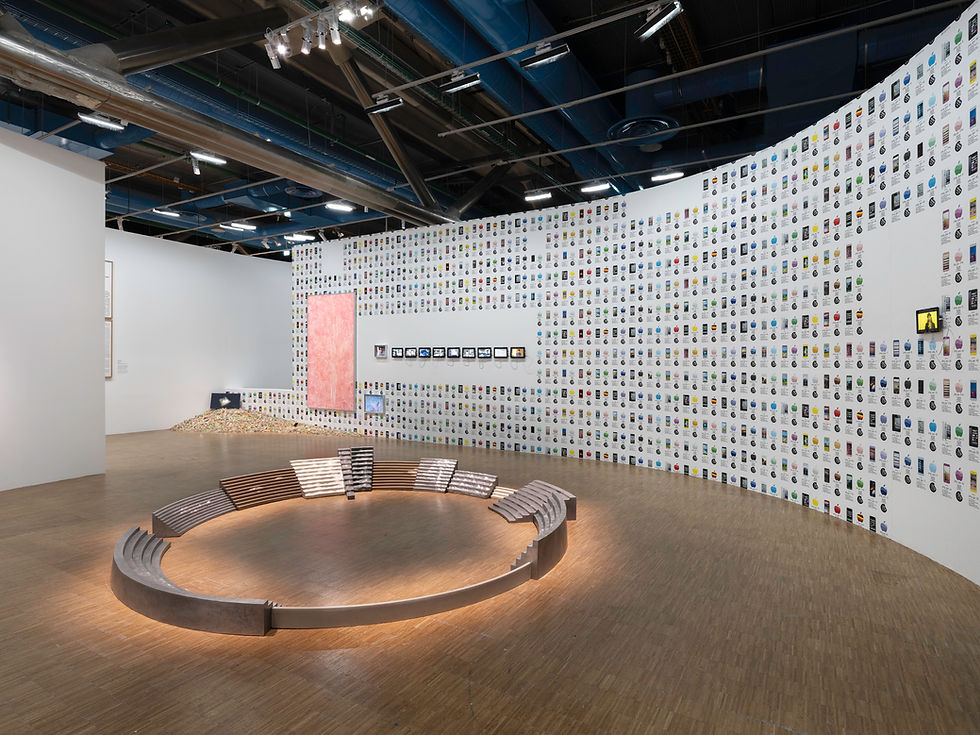
Nabuqi, The doubtful site (engulfing and radiating shapes),2018 Li Ming, Disposable Lighters-Apple, 2014–2016
Courtesy Centre Pompidou. Photo by Audrey Laurans
Li Ming's Dust on Crust on Combust brings in a corner of the factory right into the centre of the gallery. A heap of plastic lighters is piled on the floor with apparent indifference, while videos play on nearby screens, showing those same lighters slapped, dropped, and handled with restless repetition. The wall is papered with a grid of counterfeit Apple logos and iPhone mock-ups, reproduced until they lose any sense of brand identity or origin. The work stages a visual noise that resists symbolic resolution. Here, mass production is not accused as a problem to be solved, but exposed as an atmosphere unavoidable in the contemporary era. The repetition is numbing rather than didactic. The artist does not rush into a critique of labour conditions or consumer culture but offers an unfiltered observation of mass production and its sense of emptiness and exhaustion.
Ultimately, this is a diplomatic exhibition before it is a curatorial one. It performs cultural inclusion through the symbolic assembly of diverse practices under the sign of nationality. Yet, in the absence of in-depth narration of the works, the national framework supersedes specificities. The show remains occupied demonstrating a wide variety of artists, blindly celebrating the spectrum. In this way, 目 China: A New Generation of Artists gestures toward historicity while evading it. The ambition to define a generational voice is not matched by a curatorial structure or spatial resources capable of realising such a claim. What remains is an over-simplified map marked with intermittent signals.
What shaped "目China: A New Generation of Artists" at its outset was not curatorial vision but cultural diplomacy and its wider geopolitics. The exhibition was born out of the Centre Pompidou x West Bund Museum Project which first started in 2019 and then extended for another five years. Ostensibly a cultural collaboration, the exhibition coincided with the sixtieth anniversary of China–France diplomatic relations. It serves as an embodiment of soft-power cultural diplomacy. It is a diplomatic artefact: a public image of mutual recognition staged through the agreeable and exportable medium of contemporary art. This responsibility mandates the curatorial act to be diplomatic. Hence, artworks that carry connotations of certain criticality or political dissent are automatically excluded. Selective amnesia becomes crucial to ensuring that the final press photos capture a celebratory and harmonious image.
While the exhibition in a broader context is an agent of cultural diplomacy, it also materialised an organisational agenda. When institutional knowledge and resources are scarce internally, concentrated moments created with external partners can temporarily fill the gap. One of the more tangible outcomes of this partnership for the organisation has been the expansion of Pompidou's collection of Chinese contemporary art. Several works by participating artists have been acquired, effectively widening the institutional cartography of Chinese art in the French institutional context. Until recently, their existing collection and programme had an extremely limited selection of Chinese artists. The exhibition, albeit modestly, extends the landscape by introducing a younger generation of Chinese-born artists following the internationally circulated generation of artists like Ai Weiwei and Huang Yong Ping.
But the trade-off is evident. A convergence of political and diplomatic conditions allowed the exhibition to take place but with constrained parameters. The exhibition manifests the ambitions of curatorial diplomacy in a globalised world and simultaneously unveils its blind spots. It expands the institutional visibility of artists who have been underrepresented while constraining the terms of their narratives. This curatorial conundrum is not unique to Pompidou. It reflects the broader conditions that institutions in Western Europe and North America are facing—operating under economic precarity from neo-liberal policy making, major fund cuts for arts and culture and responsibility towards representation. This exhibition is not just about China and France; but it is emblematic of the contemporary conditions of the art world.
About the exhibition
"China: A New Generation of Artists"
Centre Pompidou, Paris
9 Oct 2024 - 3 Feb 2025
About the author
Kahyun Lee is an independent curator and researcher based in London and Seoul. Her work approaches curating as both a critical practice and a form of alternative knowledge production. Lee is particularly interested in how curatorial practice shaped by institutional structures, national borders, and identities, frames the narratives of East Asian contemporary art. Currently, Lee is a doctoral researcher at the Royal College of Art London and Tate Modern supported by the Arts and Humanities Research Council. Lee has previously curated programmes and exhibitions at the Design Museum, London and Busan Museum of Contemporary Art.

